
International Press Review dated 3 – 14 November 2025

This week, international media focused on discussions about the European Union’s use of frozen russian assets. European partners are considering the possibility of using the russian funds themselves, not only the income generated from them, to provide loans to Ukraine that Kyiv would not have to repay if moscow refuses to compensate for the damages caused by the war.
According to Bloomberg, the EU plan involves allocating up to €140 billion in new loans using the assets held at Euroclear in Brussels. To protect Belgium from potential lawsuits by russia, a proposal has been made to create special “zero-interest debt contracts” that would activate only if Euroclear is forced to reimburse funds to moscow.
Le Monde analyzes the so-called Norwegian solution for guarantees of a “reparations loan” to Ukraine. Economists Howard Holland and Knut Anton Mørk suggested that Norway, thanks to its oil and gas fund worth over $2 trillion, could serve as a “safety net” for the project. The country’s high credit rating allows it to take on potential risks without harming financial stability. Norway received more than €108 billion in profits from gas sales in 2022–2024, while its aid to Ukraine represents only a small fraction of that amount. Many Norwegian politicians believe the country has a moral obligation to help more, as it significantly benefited from the war launched by putin.
Prime Minister Jonas Gahr Støre has ordered a full analysis to determine possible forms of involvement. The idea has already been supported by a majority of parliamentary parties, as well as former NATO Secretary General Anders Fogh Rasmussen, who emphasized that Norway not only has the ability but also the duty to ensure Europe’s security.
In a piece by Foreign Policy, the author stresses that putin will never compromise on Ukraine, regardless of losses and the destructive consequences for russia. Nearly four years of full-scale war and twelve years since the beginning of aggression have demonstrated that no losses will stop his maniacal goal of subjugating Ukraine. Over this time, Russia has suffered colossal casualties, greater than in all its wars since World War II combined, and its economy is on the verge of collapse.
At present, the West is forced to change its approach and adopt a strategy of deterrence. The West must continue to exhaust russia by inflicting maximum losses both domestically and internationally. This means maintaining pressure on the russian economy: from confiscating frozen russian assets in Europe to expanding secondary sanctions against China, the UAE, and other countries that support russia’s war machine. It is also necessary to pressure russia’s allies — from Transnistria to Belarus — doing everything possible to weaken leaders such as Lukashenko and to support pro-European politicians, including Moldova’s president Maia Sandu. This reality must be accepted: putin cannot be persuaded; he must be outlasted.
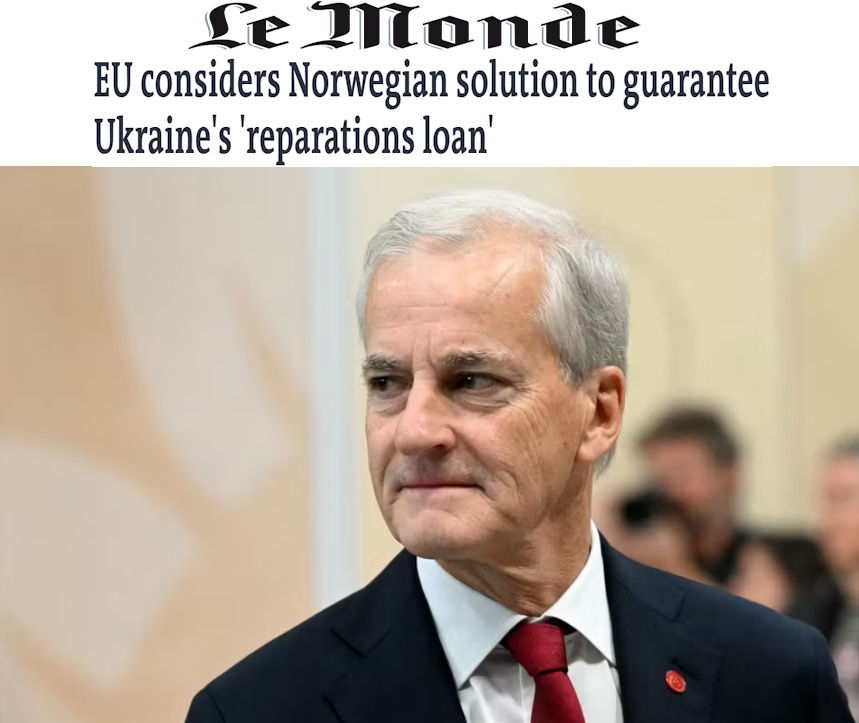
Brussels is working on a plan – dubbed the "reparations loan" – which is still fragile, but the Norwegian option could lend it credibility. The European Commission is considering using assets from Russia's central bank that were frozen across Europe to lend €140 billion to Kyiv. However, in order to do so, the Commission must be able to offer solid guarantees to Euroclear, the Belgian financial institution holding most of these assets, so that Euroclear can be confident of being reimbursed if the Russian funds were ever returned to Moscow.

Ukraine Ambassador Olha Stefanishyna said her country is engaged in “positive” talks about buying Tomahawk missiles and other long-range weaponry, even after President Donald Trump signaled he didn’t want to send them to the country.
“The discussion is still ongoing but we have a lot of delegations working to scale up the available financial resources to procure more military capabilities from the US,” Stefanishyna said in an interview with Bloomberg TV’s Balance of Power

The Group of Seven industrialized nations already agreed to leave the Russian assets untouched but allow Ukraine to tap the profits they generate. A new proposal being discussed by European Union member states would go much further, allowing the Russian money to be used to provide loans to Ukraine. The government in Kyiv may never have to repay them unless Russia’s government agrees to compensate its neighbor for the damage the war has caused.
The bloc is proceeding with extreme caution, aware that an outright asset seizure might expose member states to massive potential liabilities.

For years, there has been one guiding throughline to U.S. policy regarding Russia’s invasion of Ukraine. It wasn’t necessarily about allowing Ukraine to reclaim all of its territory, and it certainly wasn’t about a defeat of Russia outright. Instead, the West’s strategy centered on convincing Russian President Vladimir Putin that his invasion of Ukraine would ultimately fail. If Putin could be convinced that his dreams of reconquering Ukraine would never succeed, then a path to negotiation—to a stable cease-fire and even to potential peace—could be found.

Nato "will stand with Ukraine up to the day in which we will have them sitting around the table for a long-lasting peace", a senior official from the military alliance has told the BBC.
Admiral Giuseppe Cavo Dragone, chair of Nato's military committee since January, added from an operational point of view he considered the Russia-Ukraine war was bogged down, and "it was almost time to sit and talk because it's a waste of lives".
Pointing to the fact that Russia's full-scale invasion of Ukraine in 2022 had resulted in two more countries joining the Western alliance - Finland and Sweden - Adm Dragone described the war as a strategic failure for Russian President Vladimir Putin, despite recent slow, incremental advances by Russia on the battlefield.

We should speed up the drive to use frozen Russian assets to fund Ukraine’s defence and, by extension, Europe’s defence. That means ensuring Ukraine has access to the weapons and intelligence it needs when it needs them, and planning actively for the day when Russia is compelled to accept a ceasefire. A firm commitment over the coming weeks will put further pressure on Putin.
Ukraine and the UK may be at opposite ends of the European continent but our shared interests and our common cause in stopping Russian aggression make us close friends and allies. We are determined to see that friendship and alliance deepen still further in the months and years ahead.
Comments